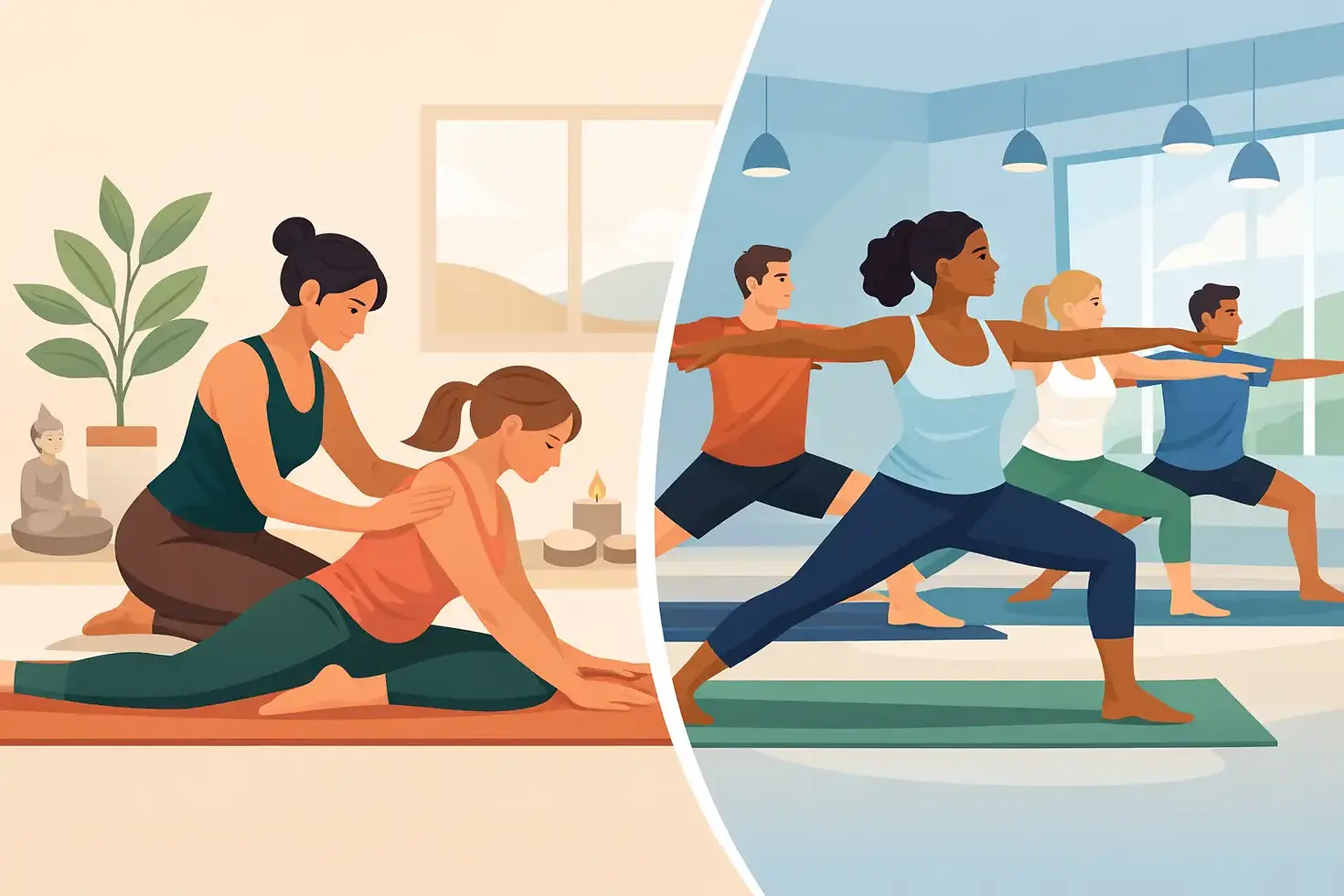
Private Yoga or Group Classes: Which Fits?

Some people know after one class that they want more individual attention. Others feel energized in a room with shared movement and a steady class rhythm. When you are deciding between private yoga or group classes, the right choice usually comes down to one thing - how much personal support your body and mind need right now.
Yoga can help with mobility, strength, stress relief, breathing, and recovery. But the setting matters. A class that feels motivating for one person can feel overwhelming or too general for another. If you are dealing with tension, pain, stress, an old injury, or simply want a practice shaped around your needs, it helps to look beyond price or convenience and consider what kind of experience will actually support you.
Private yoga or group classes for different goals
Private yoga and group yoga are not competing in the sense that one is always better. They simply serve different purposes.
Group classes work well when you want structure, community, and a regular practice at a lower cost per session. The teacher guides the room as a whole, often offering a general sequence that suits a broad range of students. That can be excellent for maintaining consistency, building familiarity with poses, and enjoying the energy of practicing with others.
Private yoga is different from the start. The session is built around you - your posture, your breathing habits, your movement patterns, your limitations, and your goals. If your shoulders are tight from desk work, your lower back feels strained, or you want to combine movement with calm breathing and nervous system support, a private session allows much more precision.
This is often where people notice the biggest difference. In a group class, you adapt yourself to the class. In a private session, the practice adapts to you.
When private yoga makes more sense
Private yoga is often the better choice when you want targeted support rather than general instruction. That does not mean you need to be injured or advanced. It simply means your body, schedule, or comfort level would benefit from a more personal approach.
If you are a beginner, private sessions can remove a lot of hesitation. Many people feel self-conscious in group settings, especially if they are unfamiliar with the poses, not very flexible, or worried about keeping up. One-to-one guidance gives you space to ask questions, move slowly, and learn correct alignment without feeling watched or rushed.
It also makes sense if you have specific physical concerns. Tight hips, neck tension, shoulder pain, posture issues, recovery after exercise, or stress-related body stiffness all respond better to individualized attention. A personalized session can focus on what needs support instead of moving through a sequence that may or may not fit your day.
Private yoga is also valuable when stress is a major factor. Some people do not need a fast-paced class. They need a calm hour with breathwork, gentle movement, and clear support that helps the body settle. In those cases, the therapeutic side of yoga becomes just as important as the physical side.
For busy professionals, private sessions can also be more efficient. You spend less time guessing what type of class to book and more time working directly on the outcome you want - better mobility, less tension, improved breathing, or a steadier routine.
Where group classes have a real advantage
Group classes still offer benefits that private sessions do not always replace. The most obvious is affordability. If you want to practice multiple times a week, group classes can make regular attendance easier on your budget.
There is also the value of momentum. Many people stay committed because a class time is fixed and the shared environment feels motivating. You show up, follow the teacher, and let the structure carry you. That simplicity can be helpful, especially if decision fatigue already takes up too much of your day.
Some students also genuinely enjoy the collective atmosphere. Breathing and moving in a room together can feel uplifting. It adds social energy without requiring social effort, which suits many people well.
Still, group classes have limits. The teacher cannot fully tailor the session to every body in the room. Even with excellent instruction, there is only so much individual correction and adaptation possible. If you need careful attention, that gap becomes noticeable.
The role of injuries, tension, and recovery
This is where the choice between private yoga or group classes becomes more practical than philosophical. If your body is asking for care, not just exercise, personalization matters.
A person with recurring neck and shoulder tension may need specific mobility work, breathing support, and pacing that reduces strain rather than adding to it. Someone recovering from intense training may need restorative movement, nervous system regulation, and selected strengthening rather than a standard flow. A client with lower back discomfort may benefit from close observation to see whether the issue is related to hamstrings, core stability, breath holding, or posture habits.
In a group class, those details can easily be missed. Not because the teaching is poor, but because the format is broad by design. In a private setting, those details become the session.
That can also create better continuity over time. When one practitioner works with you regularly, progress tends to be easier to track. The practice can change as your body changes. Some weeks you may need more strengthening. Other weeks, more release and recovery. That flexibility is hard to reproduce in a general class schedule.
Cost matters, but value matters more
It is natural to compare prices first. Group classes usually look more accessible, and for many people they are. But value is not only about the session fee. It is about whether the format helps you feel and function better.
If you attend group classes consistently and feel stronger, calmer, and more mobile, that is strong value. If you keep going to classes but still feel confused, tense, or unable to modify safely, the lower price may not actually serve you.
Private yoga costs more because the time, planning, observation, and instruction are centered on one person. For clients who want focused results, that extra attention can save time and frustration. It can also reduce the trial-and-error period that often comes with trying to find the right public class.
For some people, the best approach is not either-or. A few private sessions can create a strong foundation, then group classes become easier to follow. Others use private sessions as ongoing support alongside occasional group practice. It depends on your goals, your body, and how much guidance helps you stay consistent.
How to decide honestly
A simple question helps: do you want access to yoga, or do you want yoga tailored to you?
If you mainly want movement, routine, and shared class energy, group classes may be a very good fit. If you want personal attention, thoughtful modifications, and a practice shaped around tension, stress, recovery, or posture, private yoga is usually the better investment.
It also helps to think about your personality. Some people thrive in a room full of others. Some relax more deeply in a quiet one-to-one setting. Neither preference is more correct. The best format is the one that helps you show up without resistance.
For clients who value therapeutic support, private work often feels more reassuring. That is especially true when yoga is part of a broader wellness routine that may include massage, breathwork, and recovery practices. At A.K. Yoga & Massage, this personalized approach is central because bodies do not all hold stress in the same way, and they do not all recover in the same way either.
A better question than which is better
Instead of asking which option is best overall, ask which option fits this season of your life. If you are overwhelmed, sore, stiff, or starting from zero, private yoga may give you the clarity and care you need. If you feel stable and simply want to keep practicing, group classes may offer enough support at the right pace and price.
Your choice does not need to be permanent. It can change with your schedule, energy, budget, and physical condition. What matters most is that your practice supports your body rather than asking your body to fit into the wrong format.
The right yoga setting should leave you feeling more at home in yourself, not more pressured to keep up.